

Which advertising channel should you start with: Google, Facebook, Instagram or TikTok? The answer depends on what you sell, how people choose your products or services, and which creative assets you have available. Budget matters too. Splitting it across several platforms won’t necessarily produce better results.
In this article, we’ll look at how Meta, Google Ads and TikTok advertising differ, when each might be suitable and what to prepare before launching a campaign.
What is paid digital advertising?
Paid digital advertising allows businesses to promote their products and services across search engines, social media, websites and apps. Advertisers set a budget, choose an objective and configure the available audience or placement settings.
Digital advertising is sometimes referred to as PPC, or pay-per-click. However, that is just one billing model. Depending on the ad type, charges may also be based on impressions or video views. A purchase or enquiry can be the outcome a campaign is optimised for without being the action the platform charges for.
Digital advertising lets you compare offers, change creative assets and assess performance while a campaign is running. Tracking is never complete, though. Someone might see an ad on their phone, visit the website later on a computer and buy in a physical store. Platform reports should therefore be considered alongside website analytics and actual sales results.
Meta ads: Facebook and Instagram
People often encounter Facebook and Instagram ads while browsing friends’ posts, videos or other content. They may not be looking for your product at that moment, so the ad needs to make its relevance clear quickly.
A restaurant might show its new lunch menu, a furniture maker could present a completed project, and an event organiser might share a preview of the programme. In each case, there needs to be a clear reason to pay attention.
When should you consider Meta ads?
- You can show the offer convincingly. You have product photography, videos, examples of your work or demonstrations.
- You want to introduce something new. People may not yet know the product or service exists, so they aren’t searching for it by name.
- There is a specific reason to act. This could be an event, a seasonal offer or an opportunity to book a consultation.
- You want to reach interested people again. Where the necessary data and consent are available, remarketing can help you reach some of the people who have already interacted with your business.
The creative itself plays a significant role in Meta advertising. Audience settings won’t compensate for an unclear offer or an image that is difficult to read. It’s worth preparing several meaningfully different versions, such as a product demonstration, a customer story and an ad focused on a specific offer.
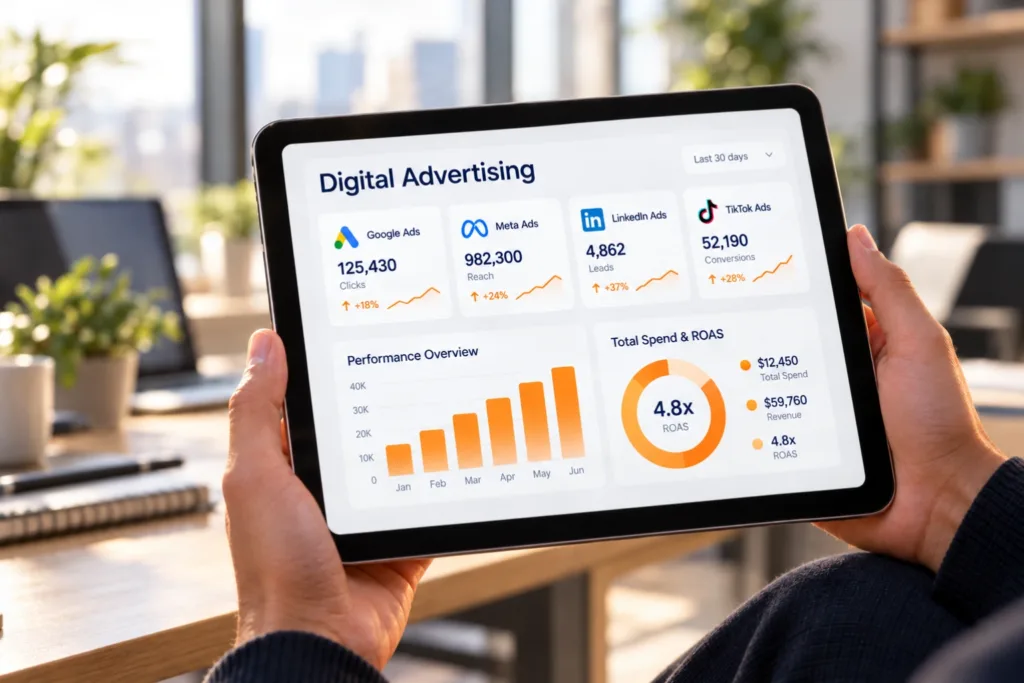
Google Ads: search advertising and other placements
Google Ads is often associated with ads in search results, but the platform also offers other placements, including display and video advertising. A Google Ads campaign doesn’t always reach people while they are actively searching.
Search ads
Search ads are worth considering when people already look for the product or service you offer. Phrases such as “plumber in Riga” or “accounting services for businesses” express a specific need that an ad can address.
However, a related search doesn’t always indicate an intention to buy. Someone looking for accounting courses has a different need from someone looking to hire an accountant. Search terms need to be reviewed, and irrelevant queries excluded where appropriate.
The landing page matters too. Someone searching for a specific service should arrive at a page explaining that service, its terms and how to enquire. Sending them to a general homepage may leave them searching for the same information again.
Display, product and video ads
Depending on the market and available ad types, Google Ads can also be used for product listings, display banners and YouTube video ads. These formats serve different purposes: showing a product, introducing a brand, explaining a service or reminding people about an offer.
Automated campaigns such as Performance Max can combine several Google advertising placements. They require clear objectives, reliable conversion tracking and suitable creative assets. Automation doesn’t remove the need to assess the purchases or enquiries a campaign generates.
When should you consider Google Ads?
Search advertising can be a suitable starting point for businesses whose services are sought out with a clearly expressed need. Before setting a budget, assess search demand, competition and how much the business can afford to spend on acquiring a customer.
TikTok ads: what can you show in a video?
When planning TikTok ads, start with a practical question: what can we show about the product or service? It might be a demonstration, a work process, a comparison or an answer to a common customer question.
A clothing shop could show different ways to style one item. A food business could film a dish being prepared. A service provider could explain what happens during a first appointment. This gives viewers useful information and a reason to keep watching.
When should you consider TikTok ads?
- Your potential customers can be reached on the platform. Check this rather than relying solely on assumptions about the audience’s age.
- Your offer can be explained through video. You have something useful to demonstrate, compare or discuss.
- You can produce several video versions. Testing requires different openings, selling points or situations.
- You have resources for ongoing content production. The budget needs to cover filming and editing as well as ad spend.
You don’t need to follow every trend or make videos look deliberately rough. A clear message, suitable pacing, understandable audio and readable captions matter more. A high view count alone doesn’t tell you whether an ad has attracted customers.
Other paid channels: Bing, Pinterest and ChatGPT
Depending on your industry and target market, other advertising channels may also be worth considering. Bing ads, managed through Microsoft Advertising, can complement Google search campaigns. Relook has achieved good results with this channel on a project targeting the US market, so we also recommend assessing its potential for businesses operating in the US and Canada.
We run Pinterest ads for businesses whose products fit naturally into the process of finding ideas and planning purchases. This is particularly relevant to home décor, including furniture, lighting, textiles and accessories. Showing a product in a room can help people picture how it might fit into their own home.
ChatGPT ads offer a newer way to reach people as they explore solutions and compare options in a conversation. They are worth considering as a separate test, with availability checked for the target market and a clear budget and evaluation criteria in place.
Which advertising channel should you start with?
Start with your customers’ needs and your business’s resources. These questions can help narrow the options:
- Are people already searching for what you offer? If so, assess Google search advertising.
- Does seeing the product or how it works create interest? Consider Meta or TikTok, depending on your audience and available creative assets.
- Does the offer need explaining before someone buys? Plan demonstrations, answers to common questions and a sufficiently detailed landing page.
- Is there enough budget for several channels? If you can only allocate a small amount to each, it may be more useful to start with one and assess its results first.
Several channels can complement one another, but each needs a clear purpose. There’s no need to advertise everywhere simply because a platform is available.
What should you prepare before launching a campaign?
- A specific objective. Decide whether you want purchases, qualified leads, event registrations or greater brand awareness.
- A clear offer. Both the ad and the website should explain what the customer receives and under what terms.
- A usable landing page. Check it on a phone, test the checkout process and submit a test enquiry.
- Reliable tracking. Make sure purchases and enquiries are recorded correctly and that data use respects users’ consent choices.
- A budget and evaluation criteria. Allow for ad spend, creative production and campaign management. Agree on the data that will guide your next decisions.
How do you know whether advertising is paying off?
Cost per click and view counts help assess ad delivery, but a sales campaign needs closer examination. How many visitors bought something? How many enquiries were relevant? How many became customers?
E-commerce businesses often use return on ad spend, or ROAS, which compares revenue attributed to advertising with ad spend. If €500 in ad spend is credited with generating €2,000 in revenue, the ROAS is 4. This doesn’t establish profitability, because product costs, delivery and other expenses aren’t included in that calculation.
For service businesses, lead quality matters. Cheap enquiries offer little value if people are looking for a different service or don’t meet the offer’s requirements. Feedback from the sales team should therefore be part of campaign evaluation.
When comparing channels, remember that several platforms may claim credit for the same purchase. You can’t simply add together the revenue shown in their reports.
Where should you begin?
Choose one clear offer, prepare a suitable landing page and ad assets, check your tracking and set a test budget. An initial campaign should also help establish what the audience responds to and whether customer acquisition costs are acceptable for the business.
If you want to understand which channel to start with or what to change in your existing campaigns, get in touch with Relook. We’ll review your offer, creative assets and available data to recommend the next steps and a considered budget allocation.